When Buildings Make Us Sick
November 5, 2025

Chenla Agathos Solutions
Team Blog
Updates and insights from our project management, construction management, and quantity surveying teams.
View on LinkedIn →
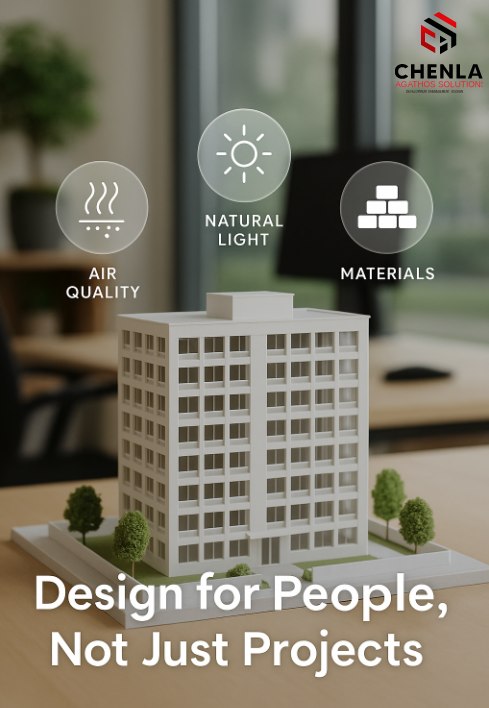
For years, project success has been defined by cost, time, and energy performance. Another measure is now impossible to ignore: the impact of buildings on human health.
Most people spend the majority of their lives indoors. Air quality, natural light, thermal comfort, and material choice shape cognition, sleep, productivity, and long-term wellbeing. These are not secondary outcomes. They are core design variables.
Building Information Modeling (BIM) is changing how teams address them. As highlighted in a recent BIMCommunity article, modelling is evolving from a coordination tool into the data infrastructure behind healthier architecture. When each element in a model carries information about VOC levels, recycled content, acoustic performance, daylighting, or airflow, design intent becomes traceable and measurable.
Simulations can project how air circulates in a clinical space, how heat moves through a façade during the hottest hours of the year, or how sunlight rhythms affect rest and alertness. This brings health-oriented design out of assumption and into evidence.
The benefits are practical. Buildings designed with wellbeing in mind tend to perform better commercially and operationally. They attract occupants, reduce turnover, and extend their relevance over time. More importantly, they create environments that support the people who use them.
At Chenla, this direction aligns with our priorities. Technology is a tool, but wellbeing is the outcome. Healthy buildings begin long before construction, in data, in modelling, and in a design philosophy that treats human health as the central measure of success.
Reference:
BIMCommunity – “BIM as the Guarantee Driving Healthy Architecture”
Ready to Build with Confidence?
Whether you need project management, construction oversight, or design coordination, we're here to help.
Related Articles

Seven BIM Practices That Reduce Construction Risk
January 23, 2026
How BIM-enabled engineering services help project teams move from reactive problem-solving to proactive risk management across design, cost, and construction sequencing.
Read more →
Five Construction Risks in Cambodia
January 8, 2026
Global construction trends don’t fail in Cambodia because they’re unfamiliar. They fail when risk is quietly relocated without the structure to absorb it.
Read more →
Better Systems, Better Projects
September 16, 2025
At Chenla, we believe great outcomes don’t just happen on site. They’re built on the systems behind the scenes, the tools, processes, and habits that turn good projects into great ones.
Read more →