Construction Risk #4 – Design Risk
December 23, 2025
Chenla Agathos Solutions
Team Blog
Updates and insights from our project management, construction management, and quantity surveying teams.
View on LinkedIn →
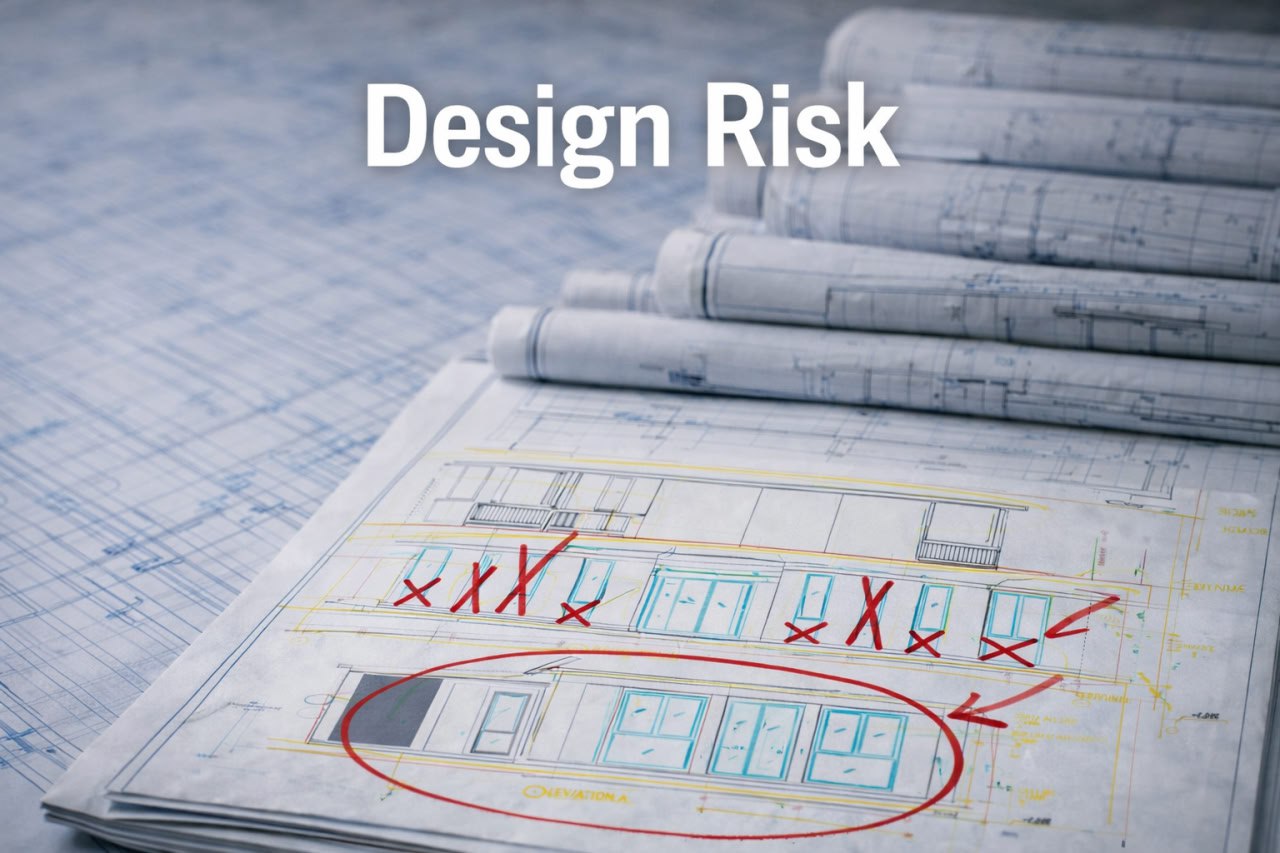
Construction Risk #4 – Design Risk
Project Management is Risk Management.
Previously, we discussed scope risk, time risk, and cost risk.
Today, we move one step upstream to a risk that often sits quietly at the beginning of a project, yet causes some of the biggest problems later:
Design Risk
In many projects, issues on site are treated as construction problems.
In reality, a large number of them start much earlier, on the drawings.
Design risk arises when:
- Drawings are incomplete or issued too late
- Architectural, structural, and MEP designs are not properly coordinated
- Design intent is unclear or difficult to build
- Key details are missing and left to site interpretation
- Design decisions are postponed until construction has already started
When design risk is not managed early, the consequences are familiar:
- RFIs multiply
- Variations increase
- Construction slows while teams wait for clarification
- Quality is compromised as temporary or ad-hoc solutions are adopted
- Disputes arise over responsibility and cost
In fast-track projects, design risk becomes even more critical.
Construction teams are forced to make assumptions, and assumptions are where risk grows.
Procurement as a Risk Multiplier
In many markets, an additional layer of design risk is introduced by how clients choose to procure design services.
Some owners attempt to reduce upfront design fees by:
- Appointing an architect only for concept design, without developing the design to a coordinated and buildable level, or
- Engaging contractors under Design & Build arrangements where the engineering design is largely developed by the contractor
Both approaches can work, but they also introduce additional risks if not properly managed.
Concept-level design often lacks the technical depth required for construction.
Contractor-led engineering design may prioritise speed, cost, or constructability over long-term performance, quality, or operational considerations.
Without clear scope definition, independent design review, and strong project management oversight, these procurement choices tend to shift design risk downstream, where it becomes far more expensive to resolve.
Why Design Risk Matters to Owners
For project owners, design risk is not just a technical issue.
It directly affects:
- Cost certainty, through variations and claims
- Programme certainty, through rework and late changes
- Quality and long-term performance of the finished building
- Safety, when buildability and detailing are not fully resolved
Simply put, it is far more expensive to fix a design problem on site than on paper.
Managing Design Risk
Effective design risk management is not about blaming designers or contractors.
It is about structure, coordination, and timing.
Key actions include:
- Early design reviews focused on buildability and interfaces
- Clear definition of design responsibilities
- Structured coordination between disciplines
- Early identification of high-risk details
- Issuing design information in line with the construction sequence
This is where professional project management adds real value, by acting as the integrator between design, construction, and the client’s objectives.
When drawings are clear, coordinated, and complete, construction becomes predictable.
And predictability is what reduces risk.
Construction Risk Series
- Scope Risk
- Time / Schedule Risk
- Cost / Financial Risk
- Design Risk
Ready to Build with Confidence?
Whether you need project management, construction oversight, or design coordination, we're here to help.
Related Articles

Calm Is a Professional Skill
January 24, 2026
In a high-pressure construction environment, calm is not slowness. It is clarity under pressure.
Read more →
Why We Stopped Managing Projects
March 24, 2026
The projects that went well didn't feel managed. They felt tended. That distinction became the basis of how we work.
Read more →
When Chaos Became Manageable
November 11, 2025
How a productivity framework helped me survive my first major project as an Owner’s Representative.
Read more →