When a Façade Change Becomes a Contract Lesson
November 26, 2025

Chenla Agathos Solutions
Team Blog
Updates and insights from our project management, construction management, and quantity surveying teams.
View on LinkedIn →
Background
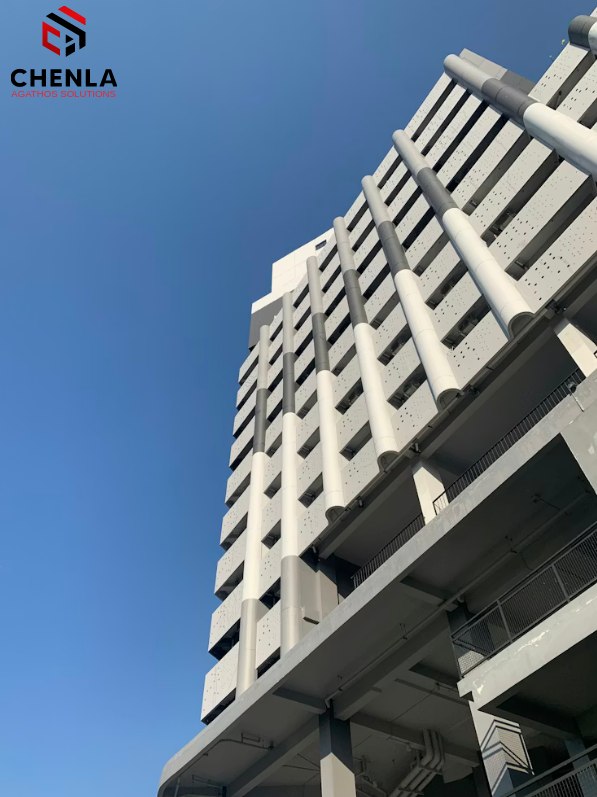
In a large government office project delivered under the FIDIC Red Book 1999, the façade was originally designed using GRC panels supported by a steel framework.
Midway through construction, the contractor informed the team that they were unable to procure the GRC system at a reasonable price due to high transportation costs. To manage this difficulty, they proposed an alternative:
➡️ cast in situ façade elements
After reviewing the proposal, both the Engineer and the Employer approved the change.
This raised an important contractual question:
Does a contractor-initiated change constitute a Variation?
1. Is this a Variation? (Yes, in principle)
Under FIDIC, a Variation does not need to originate from the Employer.
If the Engineer approves the contractor’s proposal, that approval may operate as an Engineer’s Instruction under:
- Sub-Clause 1.5
- Sub-Clause 3.1
- Sub-Clause 13 (Variations & Adjustments)
Switching from GRC to cast in situ modifies several design characteristics:
- weight
- thickness
- fixing and support details
- installation sequence
- structural loads
- temporary works
- finishes
These changes meet the definition of a Variation.
2. Does the contractor have entitlement? (Not automatically)
a. Why the contractor requested the change
Under Sub-Clause 13.2 (Value Engineering), a contractor may propose alternatives, but price adjustment is required only when the change is driven by the Employer’s needs or when it modifies design intent.
In this case, the change was driven by:
- procurement difficulty
- high transportation cost
- the contractor’s commercial risk
It was not driven by:
- safety issues
- design errors
- technical impossibility
- Employer’s instructions
- change of design intent
➡️ The cost impact remained under the contractor’s risk, not the Employer’s.
b. Was notice given on time? (No)
Under FIDIC:
- 1999 Edition: Sub-Clause 20.1
- 2017 Edition: Sub-Clause 20.2.1
A claim must be notified within 28 days.
In this project, the contractor submitted the claim eight months later, during Final Account.
➡️ The claim was time-barred.
Many Engineers take a consistent approach:
- Accept it is a Variation in principle
- Reject entitlement due to late notice
- Value only additional cost above the original design (if any)
3. Final professional assessment
A contractor-initiated change can be a Variation.
But entitlement requires:
✔️ a valid cause (Employer-driven need or genuine design change)
✔️ a timely notice (within 28 days)
In this case:
- It was a Variation
- But no cost entitlement was justified due to cause and timing
4. The lesson
Not every Variation results in payment.
Under lump sum contracts:
Entitlement is determined by both the cause of the change and the timing of notification.
Early communication and proper notice protect both the client and the contractor, and prevent disputes long after the work is done.
Ready to Build with Confidence?
Whether you need project management, construction oversight, or design coordination, we're here to help.
Related Articles

Tenders as Reconnaissance
May 11, 2026
A spa remodel was supposed to start in February. Three contractors had walked the same site for the same scope. The fourth one stopped in the first room and pointed at the wall.
Read more →
The Documentation You Skip Is the Answer You Need
April 23, 2026
He asked if the foundations were sound. The cheap answer closed eighteen months ago, with the consultants he never hired and the documents no one wrote.
Read more →
A Facade Change That Became a Contractual Lesson
November 19, 2025
In one of our earlier projects under FIDIC Red Book 1999, the facade was designed as GRC. The contractor asked to switch. The Engineer approved. But no cost entitlement followed.
Read more →